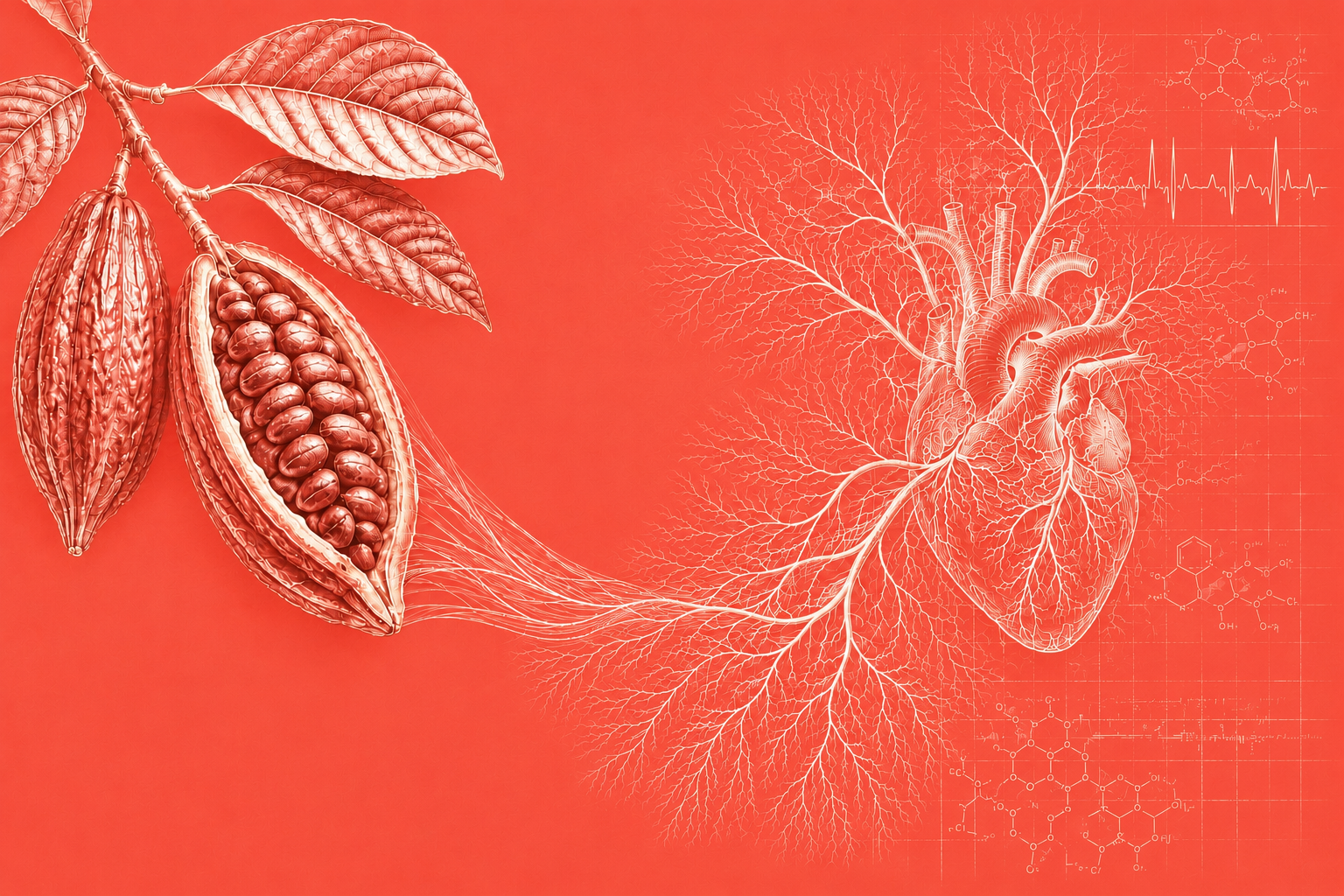
The Science Behind Ceremonial Cacao
Evidence-Based Education
Modern research continues exploring the naturally occurring compounds found in minimally processed cacao and their relationship to cardiovascular health, cognitive function, and healthy aging.
Heart Health: What the research shows
Clinical studies have investigated how naturally occurring cacao flavanols influence endothelial function, nitric oxide production, blood flow, vascular flexibility, and other markers associated with healthy circulation.
Cardiovascular health is the most extensively studied area of cacao research. While research is ongoing, this body of evidence provides the strongest scientific foundation for understanding cacao's potential role in cardiovascular health.
"Most clinical research suggests cacao flavanols may support vascular function, though outcomes vary depending on dose, duration, & population studied."
Featured clinical trial
27%
Reduction in Cardiovascular Deaths
In the COSMOS randomized clinical trial involving more than 21,000 older adults, participants receiving cocoa flavanols experienced a 27% reduction in cardiovascular death compared with placebo during a median follow-up of 3.6 years.
The study did not find a statistically significant reduction in its primary composite cardiovascular endpoint, but cardiovascular mortality was significantly lower in the cocoa flavanol group.
This finding represents a statistically significant secondary outcome from the COSMOS trial and should be interpreted within the context of the study as a whole. Additional research is ongoing.
Cardiovascular Impact
research at a glance
Blood pressure
Cocoa flavanol has been shown to reduce systolic (2.8 mm Hg) and diastolic (2.2 mm Hg) office blood pressure (BP). Greater BP reduction has been found in hypertensive patients and people younger than 50 years.
Endothelial Function
Consistently improved across many trials. cocoa flavanols boost nitric oxide availability (by stimulating nitric oxide synthase, increasing L-arginine availability, and slowing NO degradation), which relaxes blood vessels and improves flow-mediated vasodilation.
Circulation
Cacao's flavanols signal the lining of your blood vessels to switch on an enzyme (eNOS) that produces nitric oxide from the amino acid L-arginine. Simultaneously, their antioxidant activity slows how quickly that nitric oxide breaks down, so more of it stays around. The extra nitric oxide relaxes and widens blood vessels, improving blood flow, circulation and vascular flexability.
Mechanism of improvement
How cacao may support circulation
The inner lining of blood vessels, known as the endothelium, plays a central role in regulating circulation by producing nitric oxide, a signaling molecule that tells blood vessels when to relax and widen.
Cacao flavanols appear to stimulate nitric oxide production and help protect nitric oxide from breaking down too quickly. This may allow blood vessels to respond more effectively, supporting blood flow and normal vascular flexibility.
How Cacao may improve vascular flexability
Cacao improves vascular flexibility largely through the same nitric-oxide pathway, working on two timescales.
In the short term (functional flexibility): the nitric oxide that cacao flavanols trigger relaxes the smooth muscle in your artery walls. That relaxation lets vessels dilate and "give" more readily as blood pushes through with each heartbeat, rather than staying rigid. This is measured in trials as improved flow-mediated dilation — essentially how well an artery widens on demand — and it improves within hours of consuming flavanol-rich cacao, plateauing after a couple of weeks of regular intake.
Over the longer term (structural flexibility): with sustained intake, studies show reductions in arterial stiffness itself. The key markers are pulse wave velocity (how fast the pressure wave travels through your arteries — faster means stiffer) and augmentation index, both of which decrease with cocoa flavanols.
Clinical evidence
What human studies have found
Randomized clinical trials and systematic reviews have consistently investigated how cocoa flavanols influence cardiovascular health.
One of the most consistent findings has been improved endothelial function, a measure of how well blood vessels respond and dilate.
"Endothelium-dependent vasomotor function... improved by 47%."
Meta-analyses have also reported modest average reductions in blood pressure, including approximately 2.8 mmHg in systolic blood pressure and 2.2 mmHg in diastolic blood pressure. Larger effects have generally been observed among individuals with hypertension. A seperate meta-analysis review (Cochrane, 35 studies, 40 comparisons) showed reductions of 4.5mmHg systolic and 2.5mmHg diastolic.
Results vary depending on the study population, flavanol dose, product formulation, and study duration, but overall the evidence suggests cocoa flavanols may support normal vascular function.
Effects from Processing
Why processing matters
Not every cocoa or cacao product contains the same amount of flavanols. Fermentation, roasting temperature, storage, and other manufacturing decisions can all affect the concentration of these naturally occurring compounds.
Heavy processing or Alkalization—often called Dutch processing—can substantially reduce flavanol content. This is why research findings involving specially prepared, flavanol-rich cocoa cannot automatically be applied to every chocolate bar, cocoa powder, or cacao product on the market.
Consensus summary
Current scientific consensus
The evidence is strongest for a short-term improvement in endothelial function following the consumption of adequately dosed cacao flavanols. Research also suggests the possibility of modest blood-pressure benefits, although the size and consistency of the effect differ between studies.
Cardiovascular research on cacao is promising, but it should not be interpreted as proof that cacao prevents heart disease. The most responsible conclusion is that flavanol-rich cacao may support normal vascular function as one part of an overall healthy diet and lifestyle.
REPRESENTATIVE RESEARCH
The studies below represent several important human trials and evidence reviews that have shaped the current understanding of cacao flavanols and cardiovascular function.
Endothelial Function
https://pmc.ncbi.nlm.nih.gov/articles/PMC4594054/
Cocoa flavanol intake improves endothelial function and Framingham Risk Score in healthy men and women: a randomised, controlled, double-masked trial: the Flaviola Health Study
"Endothelium-dependent vasomotor function... improved by 47%."
StudyBlood Pressure
https://pubs.acs.org/doi/10.1021/acs.jafc.5b01064
Cocoa, Blood Pressure, and Cardiovascular Health
Read studyCocoa Flavanol Cardiovascular Effects Beyond Blood Pressure Reduction
Cocoa Flavanol Cardiovascular Effects Beyond Blood Pressure Reduction
https://pmc.ncbi.nlm.nih.gov/articles/PMC8031944/
COSMOS Trial
Randomized Clinical Trial: 21,442 Participants
A large-scale trial investigating cocoa-extract supplementation and major cardiovascular outcomes in older adults.
Read StudyHooper et al.
Systematic Review and Meta-Analysis
A large evidence review evaluating randomized trials of chocolate, cocoa, and cacao flavanols in relation to major cardiovascular risk factors.
Read StudyGrassi et al.
Hypertension · Endothelial Function
A controlled human study examining the effects of flavanol-rich dark chocolate on blood pressure, endothelial function, and insulin sensitivity.
Read StudyRied et al.
Meta-Analysis · Blood Pressure
A review of controlled trials investigating whether regular cocoa consumption produces measurable changes in systolic and diastolic blood pressure.
Read studySelected Scientific Literature
References
- Grassi D. et al. Hypertension.
- Hooper L. et al. Cochrane Database of Systematic Reviews.
- Sesso H.D. et al. COSMOS Trial.
- Ried K. et al. Meta-analysis of cocoa and blood pressure.
- https://pmc.ncbi.nlm.nih.gov/articles/PMC8031944/
Additional peer-reviewed references will be added as the research library expands. - https://www.ncbi.nlm.nih.gov/pmc/articles/PMC4594054/
- https://pubmed.ncbi.nlm.nih.gov/25380152/
- https://ajcn.nutrition.org/article/S0002-9165(23)02692-8/fulltext
- Effect of cocoa on blood pressure - Cochrane Review (Ried, 2017)
- https://www.jacc.org/doi/abs/10.1016/j.jacc.2010.03.039?utm_source=chatgpt.com
- Heiss C, et al.Improvement of Endothelial Function With Dietary Flavanols Is Associated With Mobilization of Circulating Angiogenic Cells in Patients With Coronary Artery Disease.Journal of the American College of Cardiology (JACC). 2010.