Mood & Mental Well-Being
Evidence-Based Education
Researchers have long been interested in cacao's reputation for promoting calm, contentment, and emotional well-being. Modern clinical studies suggest flavanol-rich cocoa may support everyday mood through several biological pathways.
MOOD & MENTAL WELL-BEING
How Cacao May Support Emotional Well-Being
For centuries, cacao has been consumed not only as a food but also within cultural and ceremonial traditions associated with comfort, connection, and wellbeing. These longstanding observations have inspired researchers to investigate how cacao's bioactive compounds might measurably influence mood.
Over the past two decades, randomized clinical trials have explored whether cocoa flavanols affect calmness, contentedness, perceived stress, mental fatigue, and overall emotional wellbeing. While the improvements observed are generally modest, the growing body of evidence suggests cacao may contribute to positive mood through several interconnected biological pathways.
Potential improvements areas
Research at a glance
Stress
Controlled studies have observed reductions in physiological stress markers, including cortisol.
In one study, women who ate dark chocolate had 21% lower cortisol levels, significantly better insulin sensitivity, and recovered faster from training than those who did not consume.
Mood
Randomized trials have reported improvements in everyday mood and reductions in negative affect.
Calmness
High-flavanol cocoa has been associated with increased calmness and contentedness after several weeks of daily intake.
Featured clinical trial
significant improvements in calmness and contentedness
In a randomized, placebo-controlled study, healthy adults consumed either high-flavanol cocoa, low-flavanol cocoa, or placebo daily for thirty days.
Participants receiving the higher flavanol dose reported significant improvements in calmness and contentedness, while the lower-dose intervention produced no measurable benefit. The findings suggest that meaningful physiological effects may depend on both flavanol dose and sustained intake.
"Higher flavanol intake was associated with greater calmness and contentedness after one month."
Primary mechanisms
How cacao may support mood
Bioactive Compounds
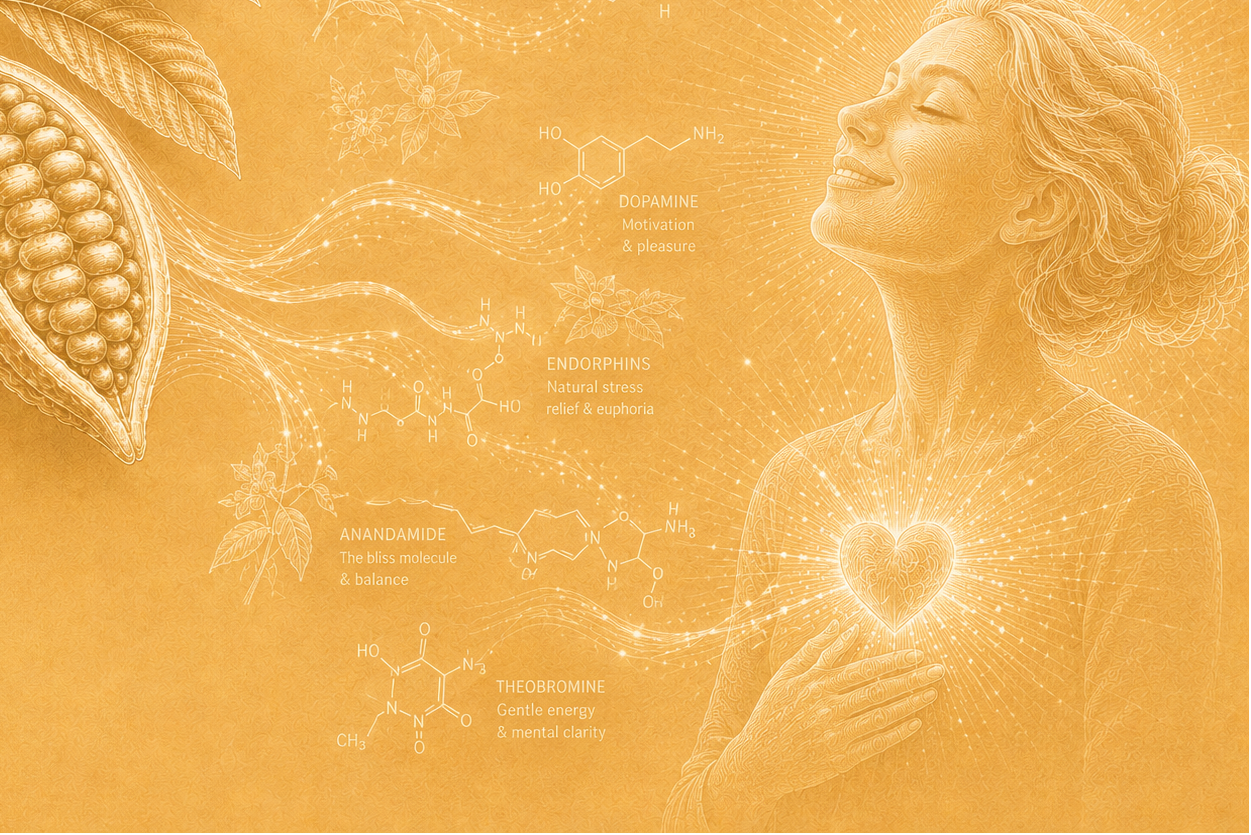
Cacao naturally contains theobromine, tryptophan, phenylethylamine, and anandamide. While these compounds often receive attention in popular discussions, current evidence suggests they are unlikely to fully explain the mood-related findings observed in clinical trials.
Stress Response
Emerging evidence suggests cocoa flavanols may influence the hypothalamic-pituitary-adrenal (HPA) axis, helping moderate aspects of the body's stress response.
Gut-Brain Axis
Cocoa consumption has been shown to alter the gut microbiome, and researchers are investigating whether these changes may contribute to improvements in mood through gut-brain communication.
Blood Flow
Improved vascular function may support healthy brain activity and emotional regulation.
Clinical evidence
What human studies have found
Across randomized controlled trials, researchers have consistently reported modest improvements in several measures of emotional wellbeing.
Participants receiving flavanol-rich cocoa have described greater calmness, contentedness, reduced negative mood, lower mental fatigue, and, in some studies, reduced perceived stress. More recent research has also demonstrated improvements in depression-related mood scores, fatigue, vigor, and anger among healthy adults.
While not every study has produced identical results, systematic reviews conclude that cocoa flavanols show promising—though not definitive—benefits for everyday mood and emotional wellbeing.
Quality
Why processing matters
Flavanols are naturally sensitive compounds that decline substantially during roasting and are further reduced by alkalization ("Dutch processing"). As a result, many commercial chocolate products contain far lower flavanol concentrations than the preparations used in scientific studies.
Researchers therefore believe that both flavanol dose and minimal processing are important considerations when interpreting the published evidence.
What the evidence suggests today
Current scientific consensus
Current evidence suggests cocoa flavanols may contribute to modest improvements in calmness, contentedness, emotional wellbeing, and aspects of the body's stress response.
Researchers generally agree that these effects are subtle rather than dramatic and are best viewed as one component of a healthy lifestyle rather than a treatment for anxiety or depression.
Additional large, long-term studies will help clarify the populations, doses, and mechanisms most likely to produce meaningful benefits.
REPRESENTATIVE RESEARCH
The studies below represent several important human trials and evidence reviews that have shaped the current understanding of cacao flavanols and cardiovascular function.
Pase et al.Journal of Psychopharmacology
High flavanol dose improved calmness and contentedness.
30-day randomized trial
Read StudyMartin et al.Journal of Proteome Research
Dark chocolate intervention associated with reductions in cortisol and stress-related metabolic markers.
Read StudyShin et al.Journal of Nutritional Biochemistry
High-cocoa dark chocolate improved mood alongside measurable changes in the gut microbiome.
Read StudyNutrition Reviews (Systematic Review)
Review of randomized trials concluded that chronic flavanol-rich cocoa interventions show promising effects on mood and emotional wellbeing while highlighting the need for larger, long-term studies.
Read studyReferences
- Pase MP et al.
- Scholey AB et al.
- Martin FPJ et al.
- Shin et al.
- Socci V et al.
- Nutrition Reviews systematic review
- Additional RCTs on cocoa flavanols and mood
- Davidson G, et al. Chocolate and cortisol response to exercise. European Journal of Nutrition, 2012
- Grassi D, et al. American Journal of Clinical Nutrition, 2005